One question was not enough
On This Day is a good idea with a narrow imagination. It asks exactly one question, what happened on this date in an earlier year, and if the answer is nothing you get nothing. Libraries are not evenly spread across the calendar, so for most people most days it comes up empty, and on the days it does fire you get the same shape of card every time.
Gallery now runs nine more rules beside it, each looking for a different shape of story. A calendar month, years ago. A whole season. The city you kept coming back to. Two people who keep showing up in the same frame. A trip whose anniversary has come round. The videos you shot and never watched again.
None of this needs tagging, sorting or any work from you. The rules read the photos you already have, their dates, their places and the faces already recognised in them, and build the memory from that.
Nine new types
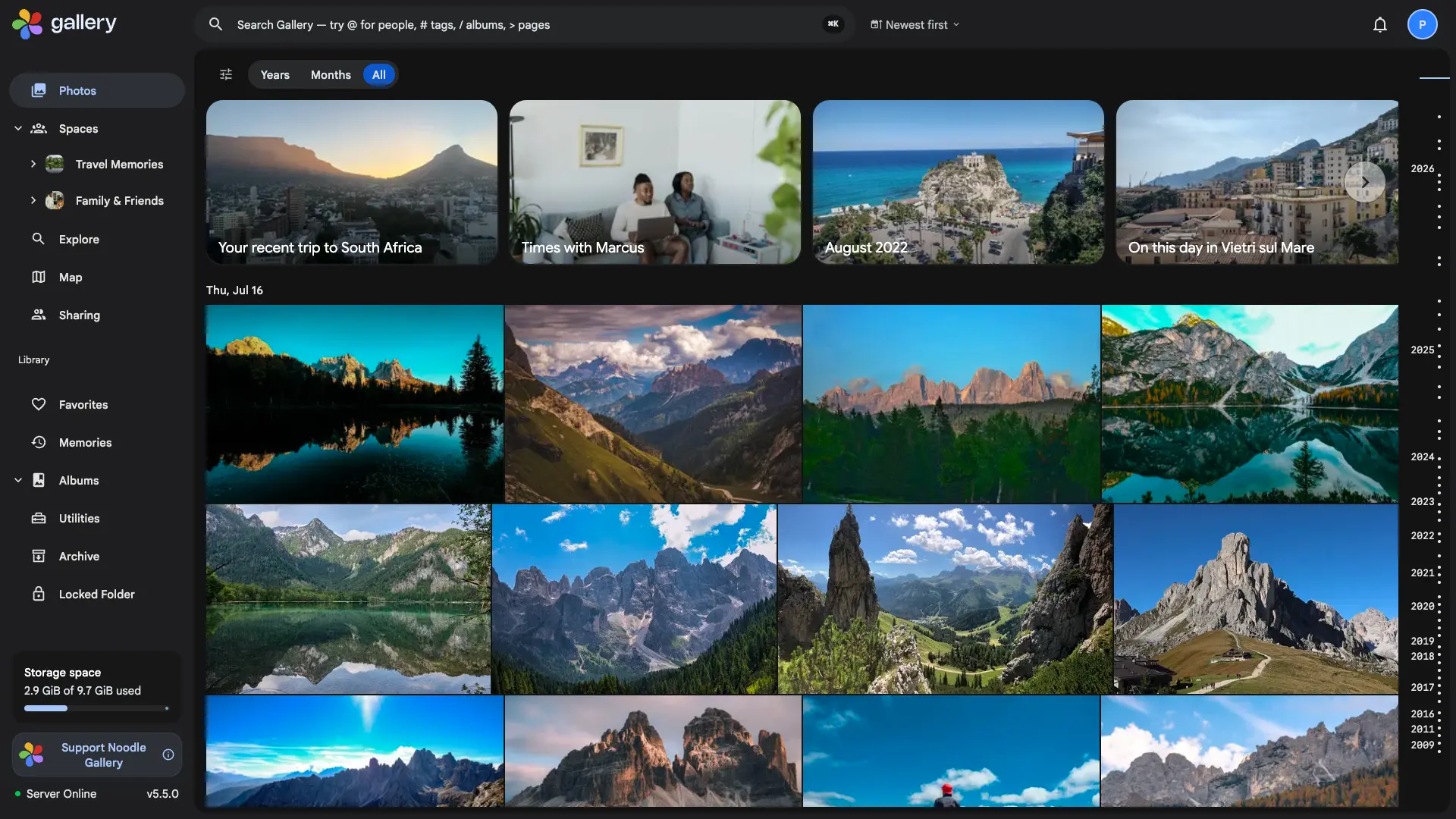
Month recap gathers a calendar month from an earlier year, "August 2022, 24 photos", and shows the strongest few years you have. Season recap does the same at season scale, grouping December with the following January and February so a winter reads as one season rather than two halves.
On this day in a place looks at a past year's photos from today's date and, when most of them cluster in a single city, names it: "On this day in Vietri sul Mare". Trip anniversary goes further out, finding a real trip, a run of days away from your usual baseline, that happened on this date in an earlier year.
Favourites throwback pulls only the photos you starred. Video moments surfaces the short clips that get buried in a timeline built for stills. People together finds a pair of named people who appear in the same photos across more than one day. Person throwback looks for someone who has been absent from your library for a year or more and brings back the densest chapter you had with them. Themed uses Smart Search to assemble a memory around a subject rather than a date.
Spread across the month, on purpose
If every rule fired on the same morning you would get one overwhelming day and then a month of silence. So they are staggered. The month recap arrives on the 1st, video moments on the 8th, a person throwback on the 13th, favourites on the 15th, people together on the 20th, a themed set on the 22nd. Season recaps land when a season turns. Places and trip anniversaries are checked every day, because they are anchored to the date itself.
Each memory then stays for a window sized to what it is: a week for a month recap, a day for a single-day place memory. The row above your timeline keeps changing as the month goes on.
Every type has a switch
Some of these are more personal than others. A memory about a person you have not seen in a year is lovely for one person and painful for another. So each type can be turned off individually in your own settings, and an administrator can disable any of them for the whole server, in which case the type never runs for anyone.
Memories generated by any rule render the same way on the web and in the mobile app, because the server sends the title and subtitle with the memory rather than leaving each client to invent its own wording. New types show up on your phone without an app update.
What it builds on
This extends Smarter memories, which introduced rule-generated recent-trip and birthday memories. It draws on the same face data as Global People and the same search index as Smart Search. Everything a rule produces lands in the Memories archive, so a memory you liked is still there after its window closes.